
September 18, 2026
Backtest vs Live Track Record: What Institutional Allocators Need to Knowa
Every quant strategy starts with a hypothesis. Before a manager can trade it with real capital, the idea is usually tested against historical data.
That backtest can show how the strategy might have performed in the past. It can reveal potential returns, drawdowns, volatility, and behaviour across different market environments. But once the strategy goes live, a different test begins.
For institutional allocators, understanding the difference between a backtest and a live track record is essential when evaluating a quant manager.
What a backtest can tell you
A backtest applies a trading strategy to historical market data to estimate how it would have performed if the strategy had been running at the time.
For a systematic manager, this is an important part of research. A backtest can help answer questions such as whether the underlying signal has persisted across different periods, how frequently the strategy trades, how large historical drawdowns might have been, and how sensitive performance is to changes in parameters.
It can also help managers understand how a strategy behaved during specific market conditions. A strategy tested across calm markets, volatility spikes, bull markets, and prolonged declines provides more information than one tested over a short or unusually favourable period.
But all of these results remain simulated.
Where backtests can go wrong
The biggest problem with a backtest is that the researcher already knows the past.
A model can accidentally incorporate information that would not have been available when a trade was made. This creates look-ahead bias. Researchers can also test many variations of a strategy and select the one that performed best historically, increasing the risk of overfitting.
The data itself can introduce problems. A dataset containing only assets that survived until today may create survivorship bias. Missing data, changing market structures, or incorrect assumptions about historical liquidity can also distort results.
Trading costs are another major issue. A backtest may assume that every order is filled at the expected price, while real execution involves spreads, fees, slippage, latency, and market impact.
A backtest can therefore look excellent on paper while being difficult to reproduce with real capital.
What changes when the strategy goes live
A live track record introduces constraints that simulation cannot fully reproduce.
Orders have to reach the market. Liquidity has to be available. Prices can move before execution. Infrastructure can fail. Exchanges, brokers, and counterparties impose real operational constraints.
The strategy also has to keep working on data that the researcher has never seen before.
This is one of the most important differences between backtested and live performance. Historical parameters can be optimized, intentionally or unintentionally, around known data. Live trading removes that possibility. Each new market event becomes a genuinely out-of-sample observation.
A live track record therefore provides evidence about both the strategy and the manager's ability to operate it in real market conditions.
Backtest vs live track record
The two types of evidence answer different questions.
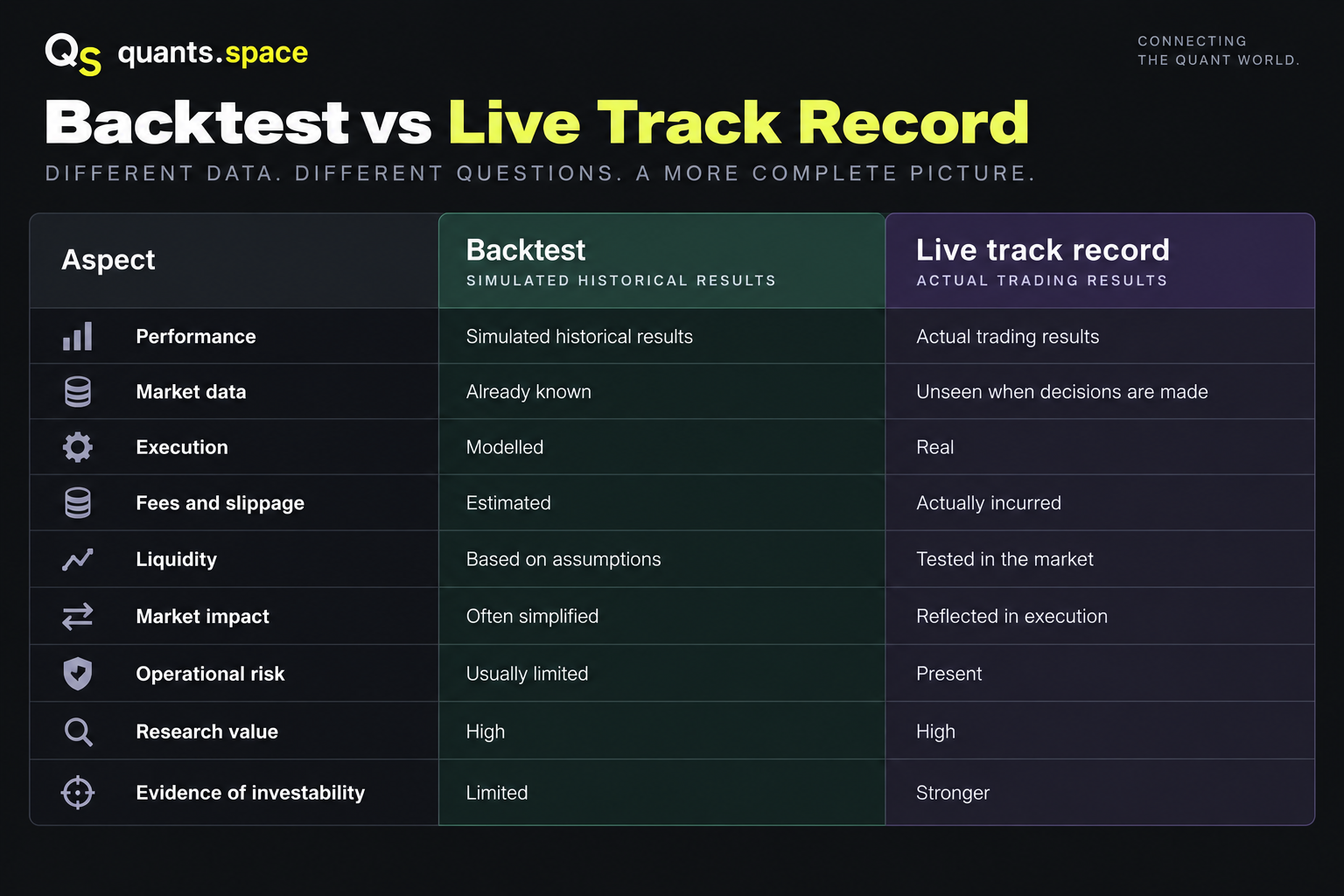
This does not make backtests unimportant. They provide information that a live record may not yet contain, particularly when the live history is short.
The important question is how closely the two align.
Compare the backtest with live results
Suppose a strategy shows a Sharpe ratio of 2.5 in its backtest and 1.3 after 18 months of live trading. That difference does not automatically mean the strategy has failed.
The allocator needs to understand why the numbers changed.
Perhaps execution costs were higher than expected. Perhaps the live period contained a market regime that was uncommon in the historical sample. The manager may also have changed position sizing, risk limits, instruments, or execution methods after going live.
A persistent gap between simulated and live results deserves investigation. The same is true when live drawdowns are consistently deeper than those observed in the backtest.
Rather than expecting the two records to match perfectly, allocators can examine whether the differences are understandable and consistent with how the strategy is supposed to work.
How much live history is enough?
There is no single number that makes a track record sufficient.
Twelve months of daily trading can produce many observations, but it may cover only one market regime. A lower-frequency strategy may need considerably longer before its behaviour becomes clear.
Allocators can look beyond the length of the record and ask what the strategy has actually experienced. Has it traded through high and low volatility? Has it experienced a meaningful drawdown? Has liquidity changed? Has the strategy operated with different amounts of capital?
The quality and relevance of the evidence matter alongside its duration.
Verify the live track record
Even a record described as “live” should be verified.
Screenshots, spreadsheets, and manager-produced performance reports can be useful for initial review, but they are still self-reported. Independent fund administration, brokerage records, exchange or custodian data, and read-only API connections can provide stronger evidence that the reported performance reflects actual trading activity.
Verification becomes particularly important when allocators are comparing several managers whose performance data comes in different formats.
Standardising and verifying those records makes the comparison more meaningful.
Use both, but know what each proves
A strong backtest can show that a strategy has been researched across a long historical period and different market conditions. A live track record shows what happened when the stratsegy met actual markets, execution costs, liquidity, and operational constraints.
Neither should be viewed in isolation.
For institutional allocators, the most useful picture comes from understanding the research behind the backtest, examining the assumptions used to produce it, and then comparing those expectations with verified live performance.
The backtest shows how the strategy was expected to behave. The live track record shows what happened when real trading began.