

September 17, 2026
Correlation in Multi-Manager Portfolios
A portfolio can contain several strong quant strategies and still be poorly diversified.
The reason is correlation. Two managers may trade different markets, use different models, and describe their strategies differently, but their returns can still move together. When that happens, adding another manager may increase the number of strategies in the portfolio without adding much diversification.
For institutional allocators building multi-manager portfolios, correlation helps answer a practical question: what does each strategy actually add to the portfolio?
Why correlation matters at portfolio level
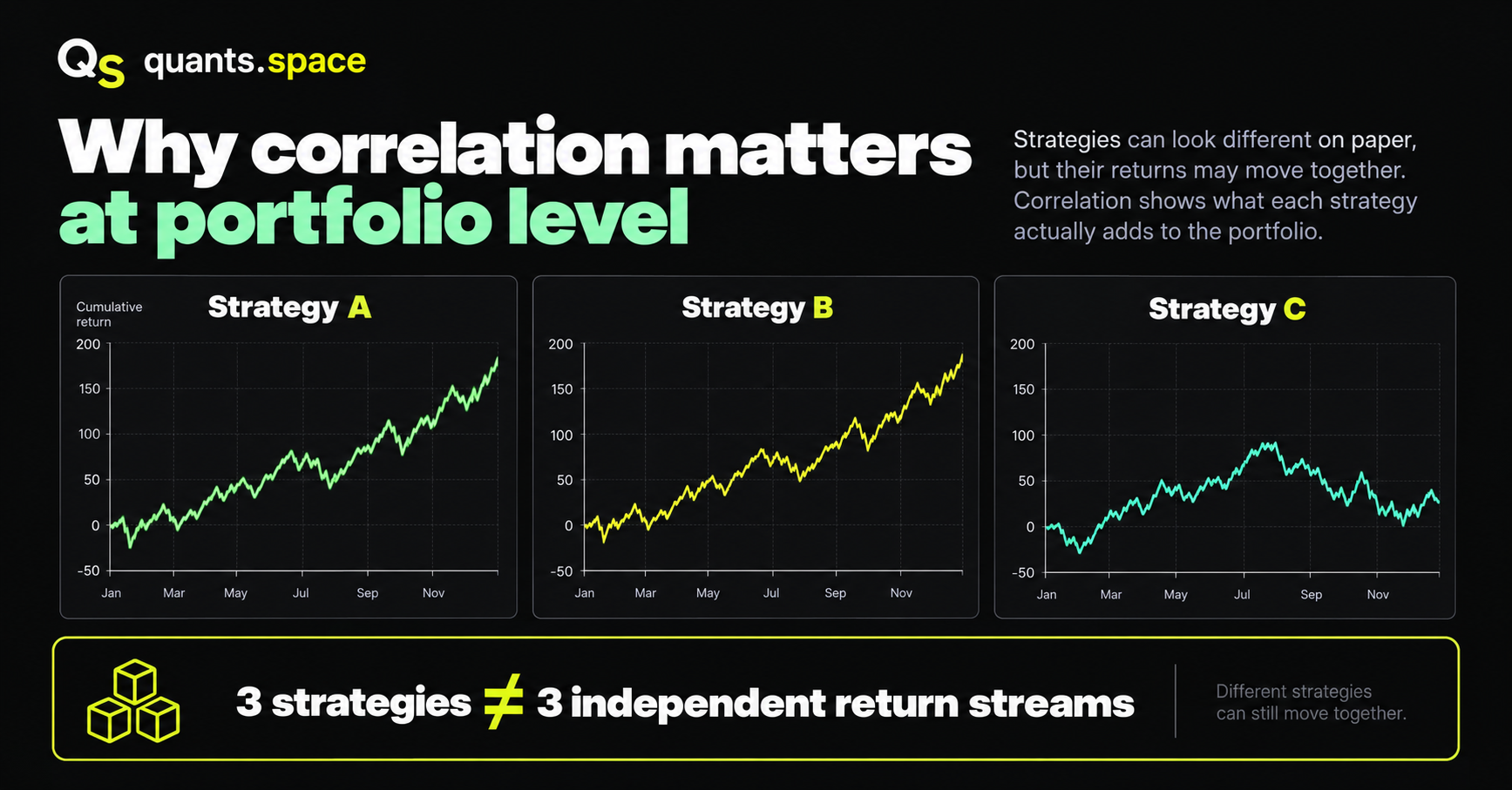
Evaluating a quant manager individually usually starts with performance and risk. Allocators may examine returns, volatility, drawdowns, Sharpe or Sortino ratios, capacity, liquidity, and the quality of the track record.
Portfolio construction adds another layer. A strategy that looks attractive on its own may behave very similarly to strategies already in the portfolio.
Consider two managers with strong historical returns and acceptable drawdowns. If their return streams are highly correlated, both may lose money at roughly the same time. The second allocation therefore provides less diversification than its standalone performance might suggest.
A strategy with more modest standalone returns but low correlation to the existing portfolio could have a different role. It may help reduce overall portfolio volatility or limit the concentration of risk in particular market environments.
This is why allocators need to evaluate both individual strategy quality and portfolio fit.
Look beyond strategy labels
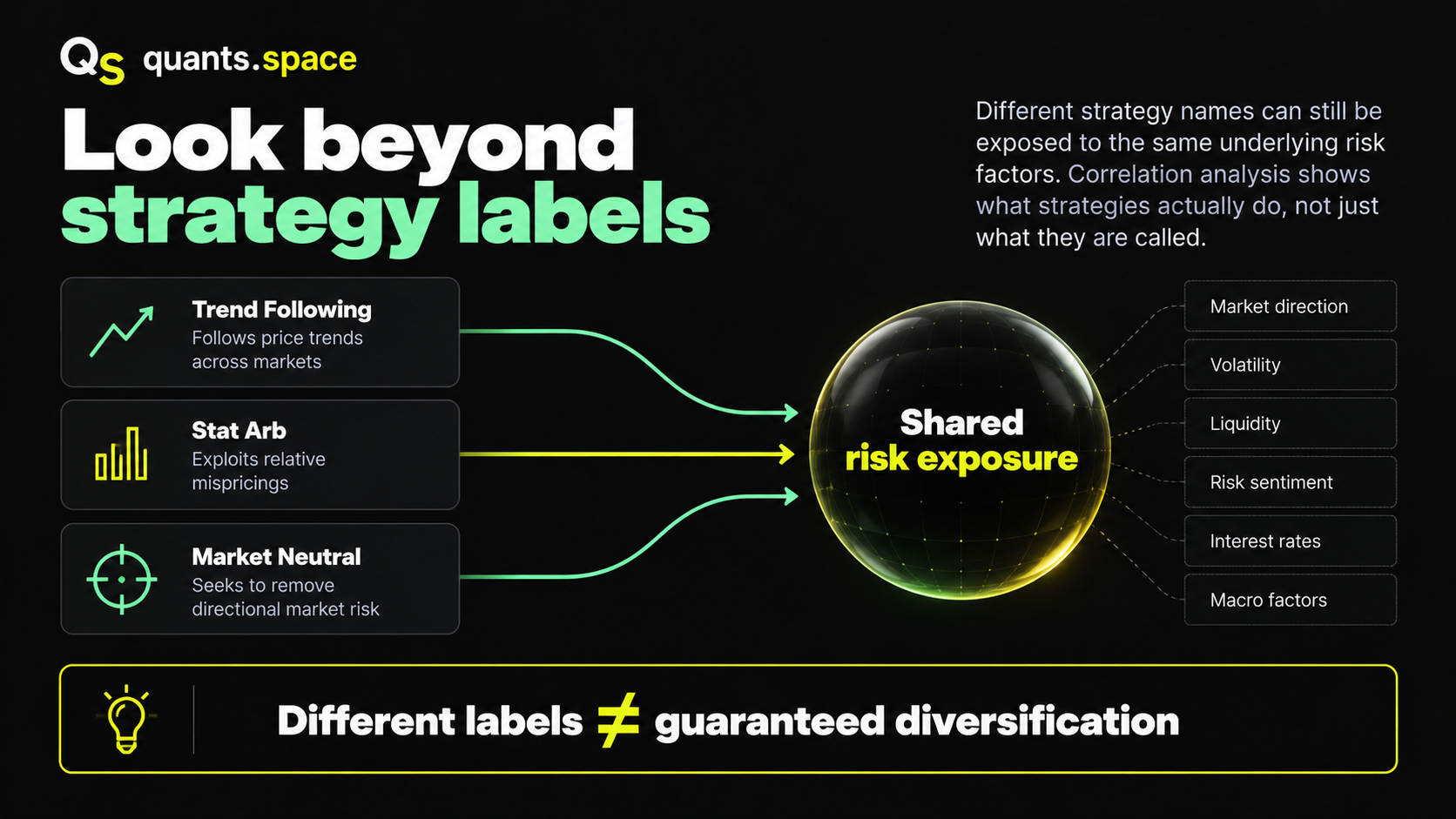
Strategy names are a useful starting point, but they do not guarantee diversification.
A trend-following strategy and a statistical arbitrage strategy may appear unrelated. Two market-neutral managers may also seem similar. Actual return data can tell a different story.
Managers can become exposed to the same underlying risk factors through different trading processes. They may respond similarly to volatility, liquidity conditions, momentum, interest rates, or changes in market risk appetite.
Correlation analysis allows allocators to compare what strategies actually did rather than assuming diversification from labels such as market neutral, arbitrage, systematic macro, or long/short.
This becomes particularly important as the number of managers increases. With ten strategies, an allocator is no longer looking at ten individual relationships. They need to understand the relationships across the entire portfolio.
Look at exposure correlation too
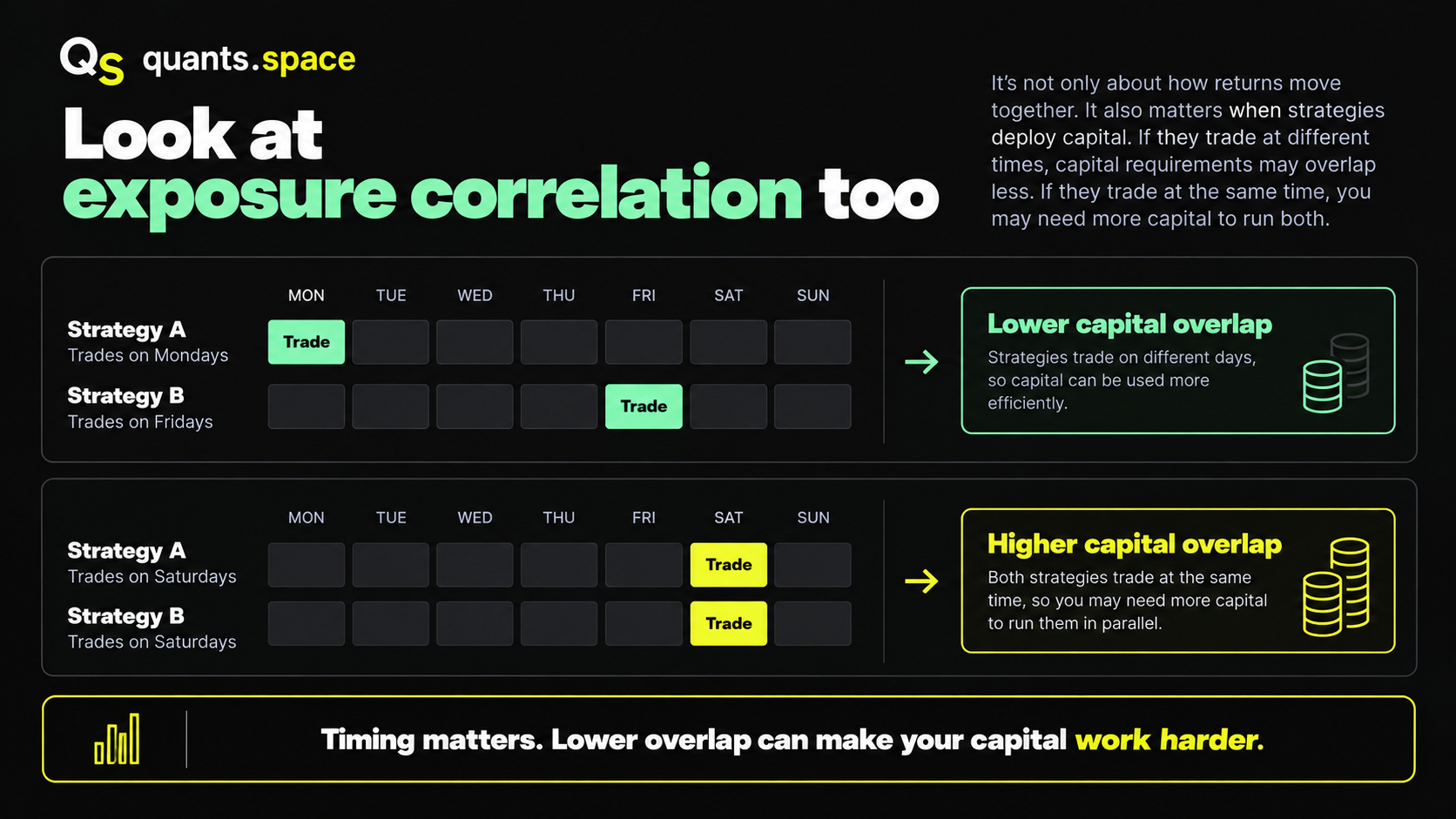
Return correlation is only one part of the picture. Allocators can also examine whether strategies tend to deploy capital at the same time.
Consider two strategies with low return correlation. If one typically trades on Mondays and another on Fridays, their capital requirements may overlap less. If both tend to deploy capital at the same time, more capital may need to remain available to support both strategies simultaneously.
This matters particularly when strategies use the same account or capital pool. Two strategies can therefore look diversified from a returns perspective while still having significant overlap in their capital usage.
Looking at both return correlation and exposure correlation gives allocators a better view of how strategies interact inside the portfolio.
Build a correlation matrix
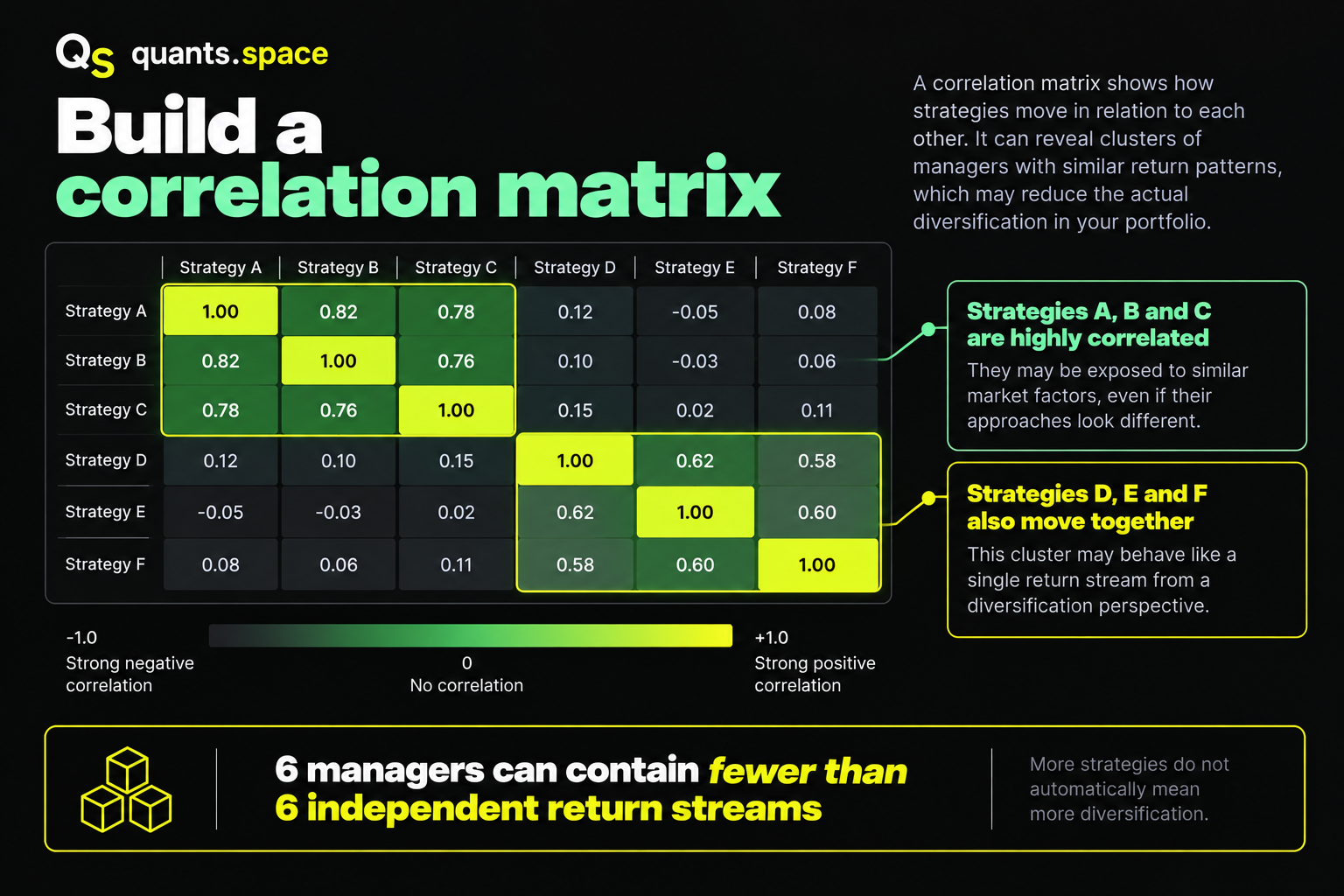
A correlation matrix is one of the simplest ways to identify these relationships.
Instead of comparing each strategy only with a benchmark, the allocator compares every strategy with every other strategy in the portfolio. This can reveal clusters of managers whose returns tend to move together.
Suppose a portfolio contains six quant strategies. Three have relatively low correlations with the rest of the portfolio, while another three are strongly correlated with one another. On paper, the allocator has six managers. From a diversification perspective, however, the portfolio may contain fewer genuinely distinct return streams.
The matrix can also help when evaluating a new manager. The relevant question is not simply whether the strategy has low correlation to the S&P 500 or Bitcoin. An allocator can compare it directly with the strategies they already hold.
Correlation can change
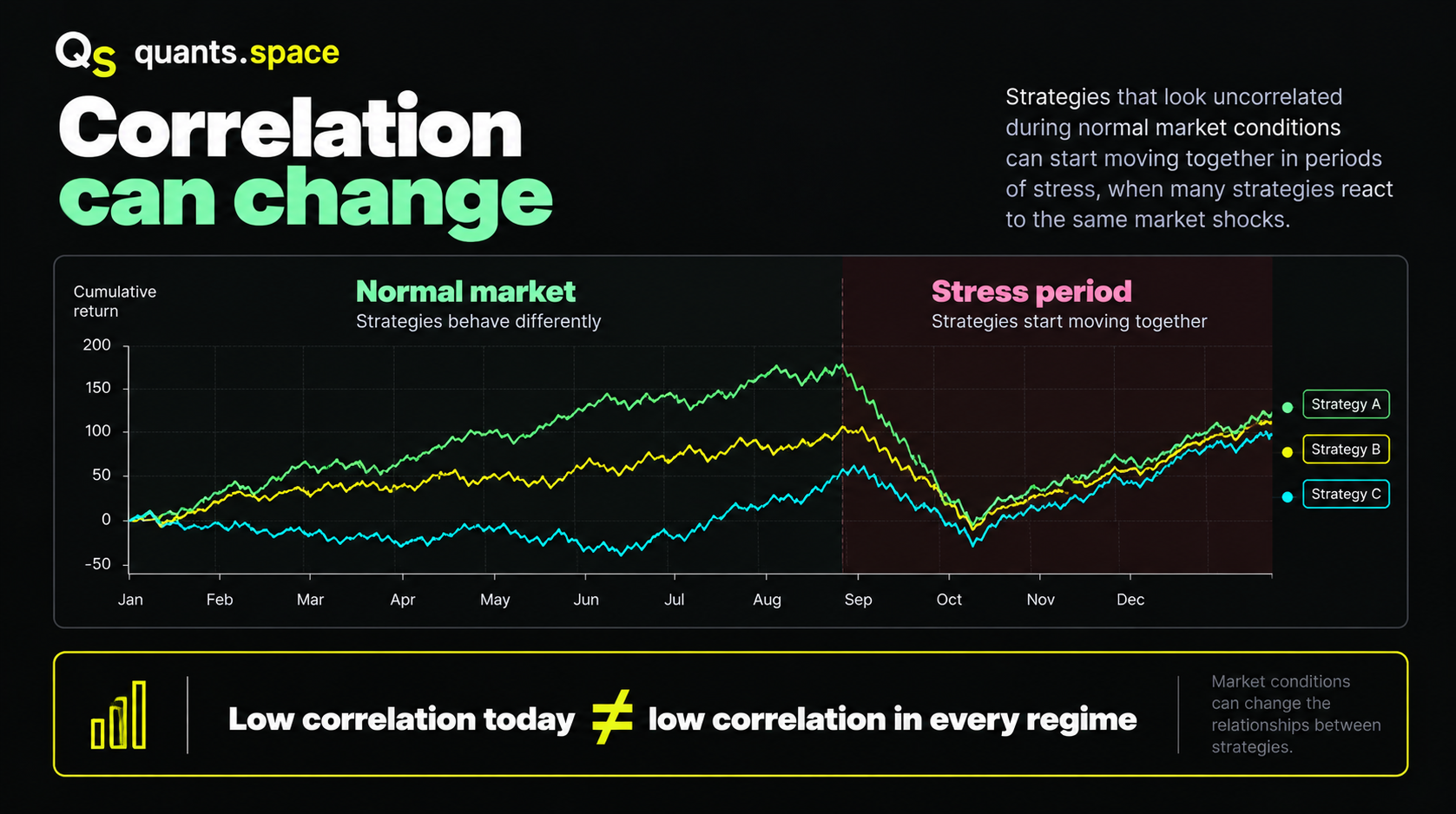
Historical correlation is useful, but it is not permanent.
Relationships between strategies can strengthen or weaken as market conditions change. Strategies that appeared independent during normal markets may begin moving together during periods of stress.
This can happen because managers reduce risk at the same time, liquidity disappears across several markets, volatility rises, or different models respond to the same market shock.
For this reason, a single correlation number calculated over an entire track record can hide important information. Allocators can examine correlation over different periods and market regimes, including drawdowns and high-volatility environments.
Rolling correlation can also show whether relationships between strategies are becoming stronger or weaker over time.
Low correlation is not automatically better
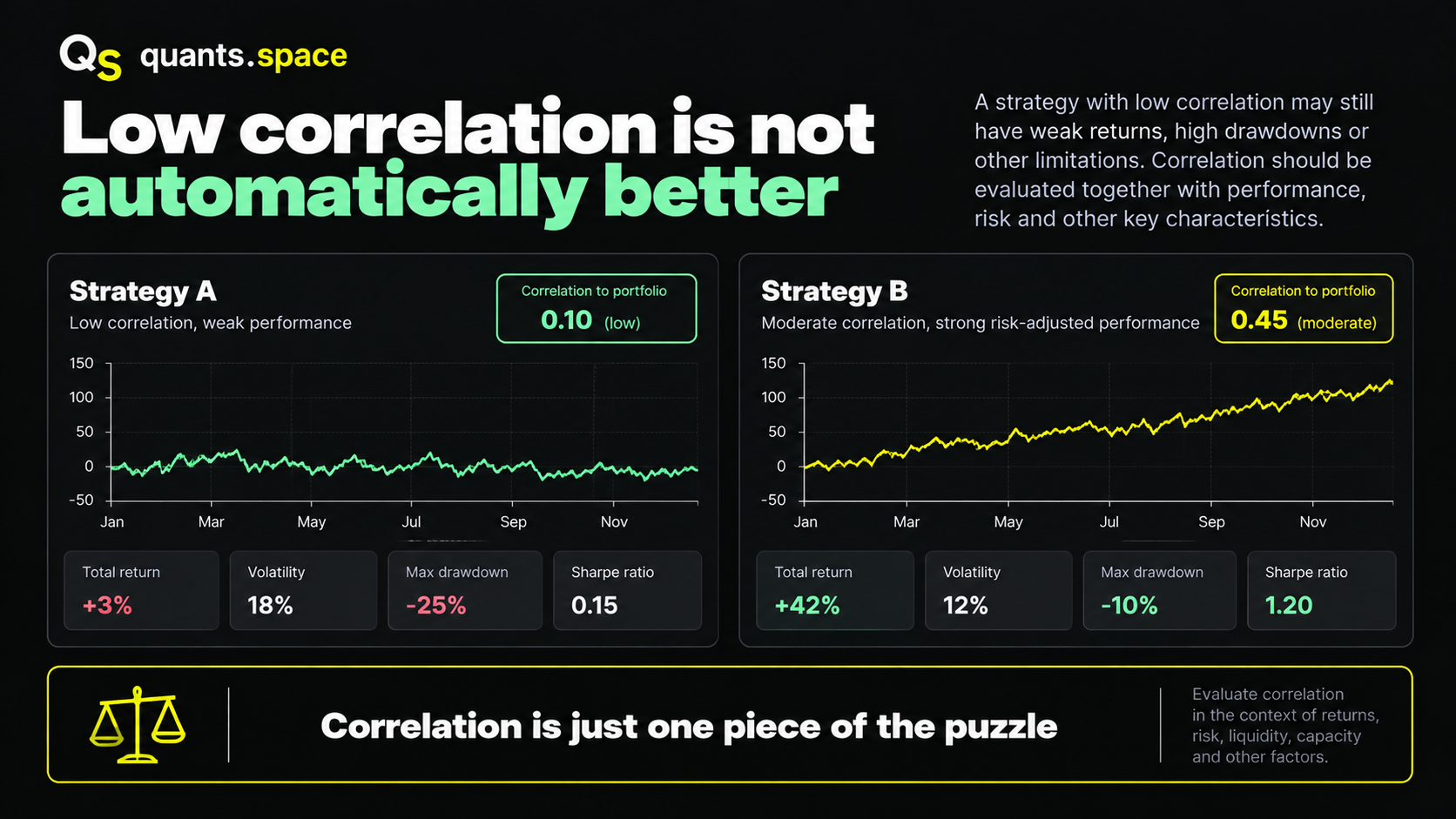
Correlation should not become a target on its own.
A strategy with very low correlation may still have weak returns, excessive drawdowns, poor liquidity, limited capacity, or an unreliable track record. Adding it purely because it looks different does not necessarily improve the portfolio.
Likewise, some correlated strategies may still deserve allocations if they provide attractive risk-adjusted returns or offer different execution, liquidity, capacity, or market exposure.
The objective is therefore not to minimize correlation at any cost. It is to understand how each manager changes the overall portfolio.
Correlation should be combined with other risk measures
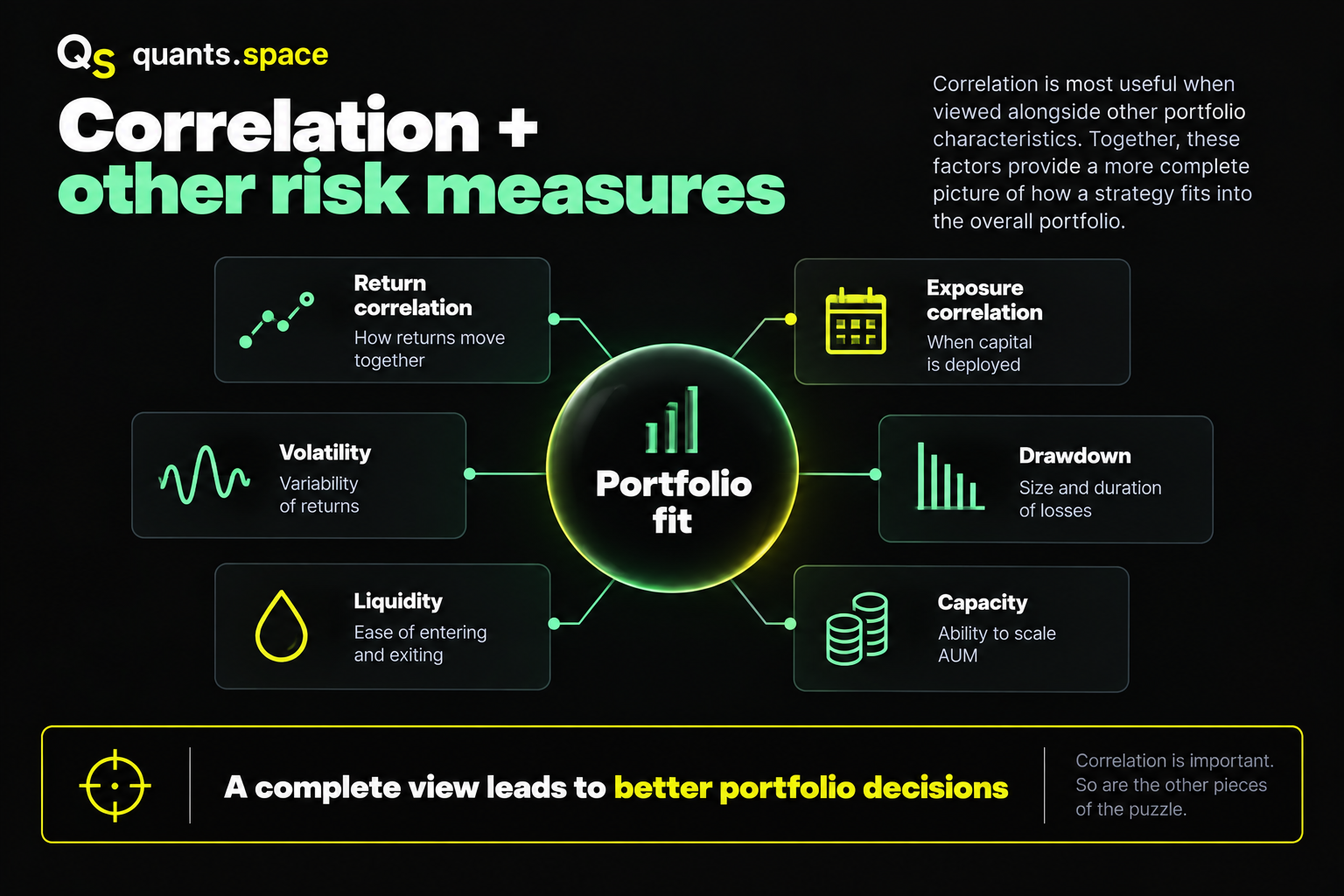
Correlation is most useful when viewed alongside other portfolio information.
Allocators can examine how a new strategy affects expected volatility, drawdowns, risk concentration, liquidity, and exposure to different markets or trading styles. They can also run scenario and stress analysis to see what might happen if several strategies experience losses simultaneously.
The same principle applies to allocation size. Two strategies do not contribute equally to portfolio risk simply because they receive equal capital allocations. Their volatility and correlation with the rest of the portfolio also matter.
This makes correlation part of a broader portfolio construction process rather than a standalone screening metric.
From manager selection to portfolio construction
Finding strong managers is only the first step in building a multi-manager quant portfolio.
Once several strategies are combined, the allocator needs to understand how their return streams interact. Correlation analysis can reveal hidden overlap, identify potential diversification, and show whether a new strategy adds something meaningfully different to the existing portfolio.
A portfolio with more managers is not necessarily more diversified. What matters is how those managers behave together.