

September 21, 2026
Quant Strategy Liquidity: What Institutional Allocators Need to Know
A quant strategy can have strong returns, controlled drawdowns, and an attractive Sharpe ratio, but still be difficult to allocate to at scale.
One reason is liquidity.
Every strategy depends on the ability to enter and exit positions at prices close to those assumed by the model. As capital increases, that becomes harder. Orders get larger, execution takes longer, and trading itself can begin to move the market.
For institutional allocators, liquidity therefore affects more than execution. It influences capacity, risk, allocation size, and how quickly capital can be withdrawn when market conditions change.
Where does the strategy trade?
Liquidity starts with the instruments and markets a strategy uses.
A systematic strategy trading highly liquid large-cap equities or major futures contracts operates in a different environment from one trading small-cap stocks, less liquid crypto assets, or niche derivatives.
Average trading volume can provide a useful starting point, but it does not tell the whole story. Liquidity can vary significantly by time of day, market regime, instrument, and position size.
An allocator therefore needs to understand not only what a strategy trades, but how much liquidity is normally available relative to the capital the strategy needs to deploy.
Strategy liquidity is also about execution
Two managers can trade the same market and still face very different liquidity constraints.
A low-turnover strategy that holds positions for several weeks may tolerate slower execution. A high-frequency or short-term strategy may depend on entering and exiting positions within seconds or minutes.
This makes execution part of the liquidity assessment.
Suppose a backtest assumes that a strategy buys an asset at $100. In live trading, a small order might execute close to that price. A much larger order could consume available liquidity across several price levels, pushing the average execution price higher.
The difference is market impact.
As assets under management grow, a strategy that worked efficiently with $10 million may behave differently with $100 million.
Liquidity and capacity are closely connected
This is where liquidity becomes a capacity problem.
Every strategy has some practical limit to the amount of capital it can deploy without materially changing its expected performance. That limit depends partly on the liquidity of the markets being traded.
A strategy may continue accepting capital after reaching its most efficient size, but larger orders can increase slippage and market impact. Returns may gradually deteriorate even though the underlying signal has not changed.
For allocators, this creates an important question:
How much additional capital can the strategy absorb before execution begins to erode the edge?
The answer cannot be determined from AUM alone. A $500 million strategy trading deep futures markets may have more room to grow than a $50 million strategy concentrated in less liquid instruments.
What happens when everyone wants to exit?
Liquidity often looks strongest when it matters least.
During normal market conditions, a manager may be able to enter and exit positions with limited impact. During periods of stress, the same market can behave very differently.
Bid-ask spreads can widen. Market depth can disappear. Volatility can increase, and many participants may attempt to reduce similar positions at the same time.
This creates liquidity risk precisely when a portfolio may need flexibility most.
Historical analysis should therefore include difficult market periods rather than relying only on average trading conditions. Allocators can examine how the strategy behaved during volatility spikes, sharp sell-offs, exchange disruptions, or other periods when liquidity deteriorated.
A simple liquidity review
Rather than looking for a single liquidity metric, allocators can examine several characteristics together:
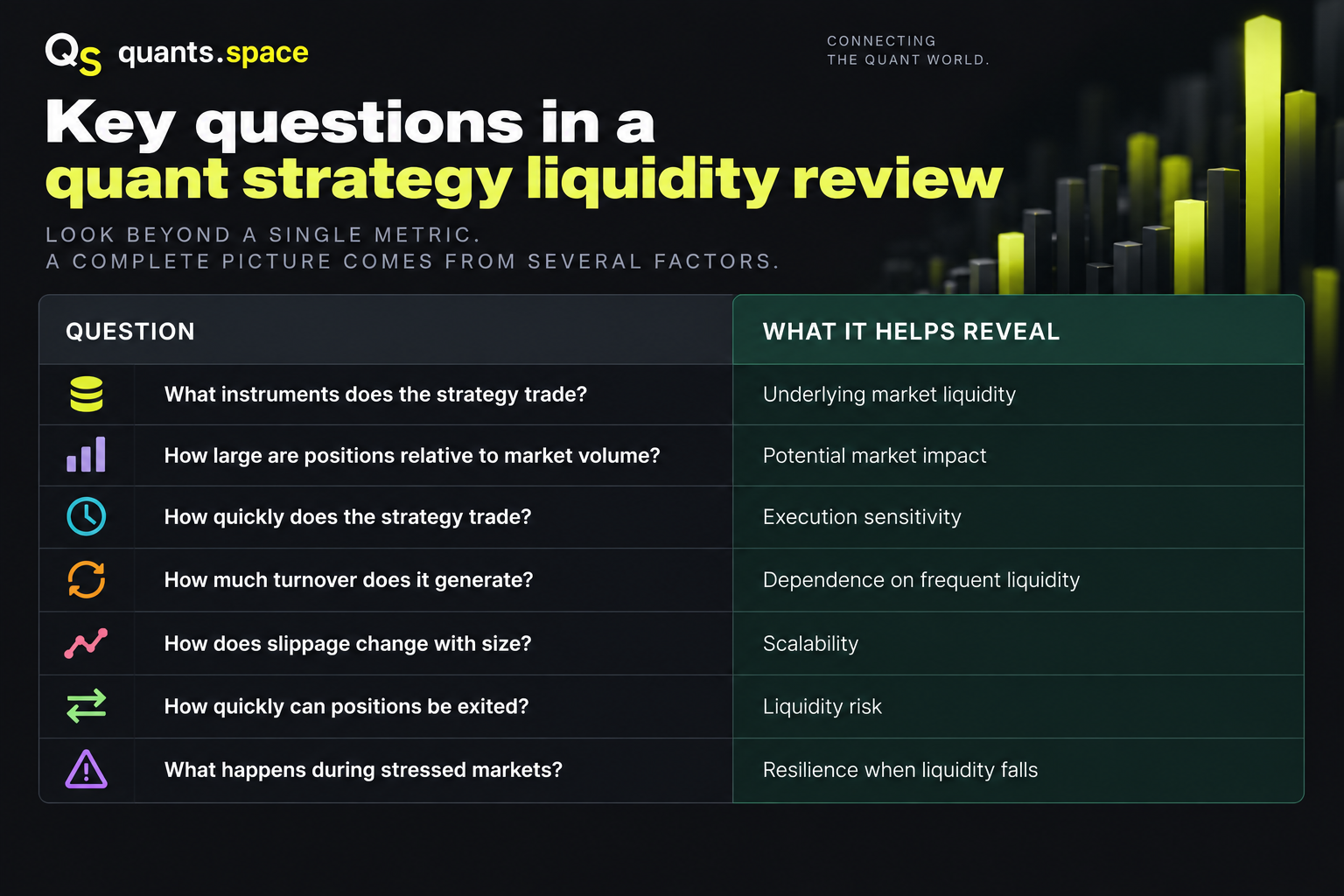
The goal is to understand how dependent the strategy is on liquidity remaining available under the conditions assumed by the model.
Liquidity also matters at portfolio level
An individual strategy may appear liquid on its own while still creating concentration at portfolio level.
Several managers may trade the same instruments, rely on similar execution windows, or attempt to reduce exposure during the same market events. This creates liquidity overlap even when their return streams are not highly correlated.
For a multi-manager allocator, it is therefore useful to examine liquidity across the entire portfolio rather than manager by manager.
If several strategies need the same liquidity at the same time, their combined exposure can become more important than any individual allocation.
From attractive returns to investable returns
Liquidity is easy to overlook when evaluating historical performance because it often appears indirectly through execution costs, slippage, and capacity.
But those effects become increasingly important as capital grows.
A strategy that generates attractive returns at small scale is not automatically capable of producing the same results with institutional capital. Allocators need to understand what the strategy trades, how it executes, how much capital the markets can absorb, and what happens when liquidity deteriorates.
The relevant question is therefore not only how well has the strategy performed?
It is also how much capital can realistically access those returns?