
November 24, 2026
The Data Problem: Why More Market Data Doesn't Always Mean Better Models
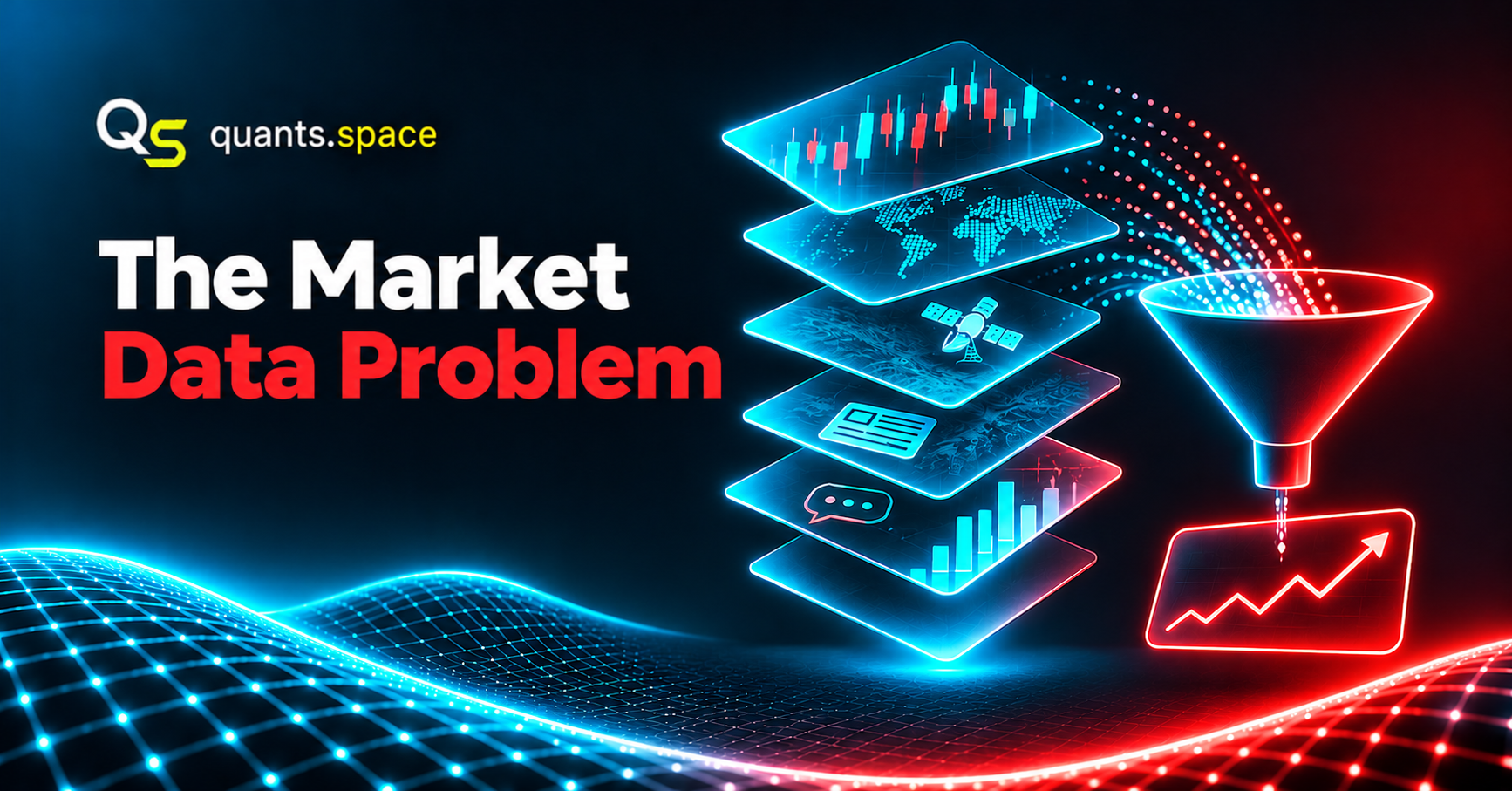
Quantitative trading has entered an era of unprecedented data availability. Researchers can access decades of historical prices, tick-level transactions, order book updates, satellite imagery, sentiment indicators, and alternative datasets. The assumption is that more information should lead to more accurate predictions and stronger trading strategies.
Financial markets, however, rarely follow this logic. Increasing the volume of market data can introduce additional noise, statistical bias, and unnecessary model complexity. For quantitative researchers, the challenge is identifying which information contributes to reliable and actionable investment decisions.
The Signal-to-Noise Problem in Market Data
Financial markets generate enormous amounts of information, but only a fraction of it contains meaningful predictive signals. Much of the available data reflects random price movements, temporary liquidity imbalances, and market microstructure effects.
As datasets expand, distinguishing genuine signals from statistical noise becomes increasingly difficult. Machine learning models are particularly vulnerable because they can identify complex relationships that appear significant in historical data but have little predictive value in live markets.
A larger dataset can therefore produce a more sophisticated model without improving its ability to generate sustainable alpha.
Why More Data Can Lead to Overfitting
Overfitting occurs when a quantitative model learns patterns specific to its training dataset rather than relationships that generalize to unseen market conditions.
Adding more variables, instruments, and alternative data sources increases the number of potential relationships a model can discover. Some of these relationships will appear statistically significant purely by chance.
Common warning signs of overfitting include:
- Exceptional backtest performance followed by weak live results
- High sensitivity to small parameter changes
- Poor performance across different market regimes
- Dependence on a narrow set of historical events
- Excessive model complexity relative to predictive improvements
Researchers can mitigate these risks through out-of-sample testing, walk-forward validation, regularization, and disciplined feature selection. Accounting for multiple hypothesis testing is equally important when evaluating large numbers of potential trading signals.
Data Quality Matters More Than Data Volume
The reliability of quantitative trading models depends heavily on the quality of their underlying financial data. Even extensive datasets can produce misleading results when they contain structural errors or inconsistencies.
Several data quality issues deserve particular attention:
- Survivorship bias: Excluding delisted securities or failed companies from historical datasets
- Look-ahead bias: Using information that was unavailable at the time of a simulated trading decision
- Timestamp inconsistencies: Misaligning market events across exchanges or data providers
- Missing observations: Introducing distortions through incomplete records
- Corporate action errors: Incorrectly adjusting prices for dividends, splits, and other events
These problems can create artificial performance advantages that disappear once a strategy enters live trading. A smaller, carefully validated dataset may provide a more reliable research foundation than a substantially larger collection of unverified information.
The Hidden Cost of Alternative Data
Alternative data has become an important component of quantitative research. Sources such as consumer transactions, web traffic, news sentiment, and geolocation information can offer insights beyond traditional financial indicators.
However, alternative datasets introduce additional operational and analytical challenges. Historical coverage may be limited, collection methodologies can change, and the relationship between a dataset and asset prices may weaken as competing market participants adopt similar signals.
Quantitative teams must also consider acquisition costs, licensing restrictions, compliance requirements, processing infrastructure, and ongoing maintenance. The economic value of a dataset ultimately depends on whether its contribution to strategy performance justifies these expenses.
Market Regimes and the Limits of Historical Data
Financial markets are nonstationary. Relationships between variables evolve as monetary policy, regulation, technology, liquidity, and participant behavior change.
A model trained on decades of historical market data may capture relationships that are no longer relevant. Conversely, relying exclusively on recent observations can leave a strategy unprepared for rare but significant market events.
Quantitative researchers must balance historical coverage with the relevance of past market conditions. Regime analysis, rolling training windows, and stress testing can help identify which historical relationships remain useful under changing circumstances.
How Quantitative Teams Build Better Data Strategies
Effective data management begins with a clearly defined research objective. Before acquiring additional datasets, researchers should establish what information they need, why it may contain predictive value, and how its contribution will be measured.
A disciplined approach typically includes:
- Defining an economic rationale for each proposed signal
- Validating data accuracy, consistency, and availability
- Measuring incremental predictive value against existing features
- Testing model robustness across multiple market environments
- Evaluating performance after transaction and data acquisition costs
- Monitoring signal decay and changes in data quality
This framework helps quantitative teams allocate research resources more efficiently while reducing unnecessary model complexity.
What Institutional Allocators Should Look For
For institutional allocators evaluating quantitative managers, data practices can reveal important aspects of research discipline and operational maturity.
Understanding how managers source, validate, and integrate market data provides insight into the reliability of reported performance. Allocators should examine how teams prevent data leakage, manage alternative data costs, validate new signals, and monitor changes in model behavior.
A manager's ability to explain why specific datasets are valuable can be more informative than the size of its data infrastructure or the number of features incorporated into its models.
Conclusion
Access to market data is essential for quantitative trading, but its value depends on how effectively it is selected, validated, and applied. Larger datasets can expand research opportunities while simultaneously increasing the risks of overfitting, statistical noise, and operational complexity.
The strongest quantitative research processes prioritize data integrity, economic reasoning, and robust validation. As financial information becomes increasingly accessible, competitive advantage will depend on the ability to extract reliable signals and translate them into sustainable investment performance.
At quants.space, we connect quantitative managers, researchers, and institutional allocators, helping market participants discover systematic strategies, evaluate investment opportunities, and access specialized quantitative talent.