
November 16, 2026
Why Quant Strategies Look Better in Backtests Than in Live Trading
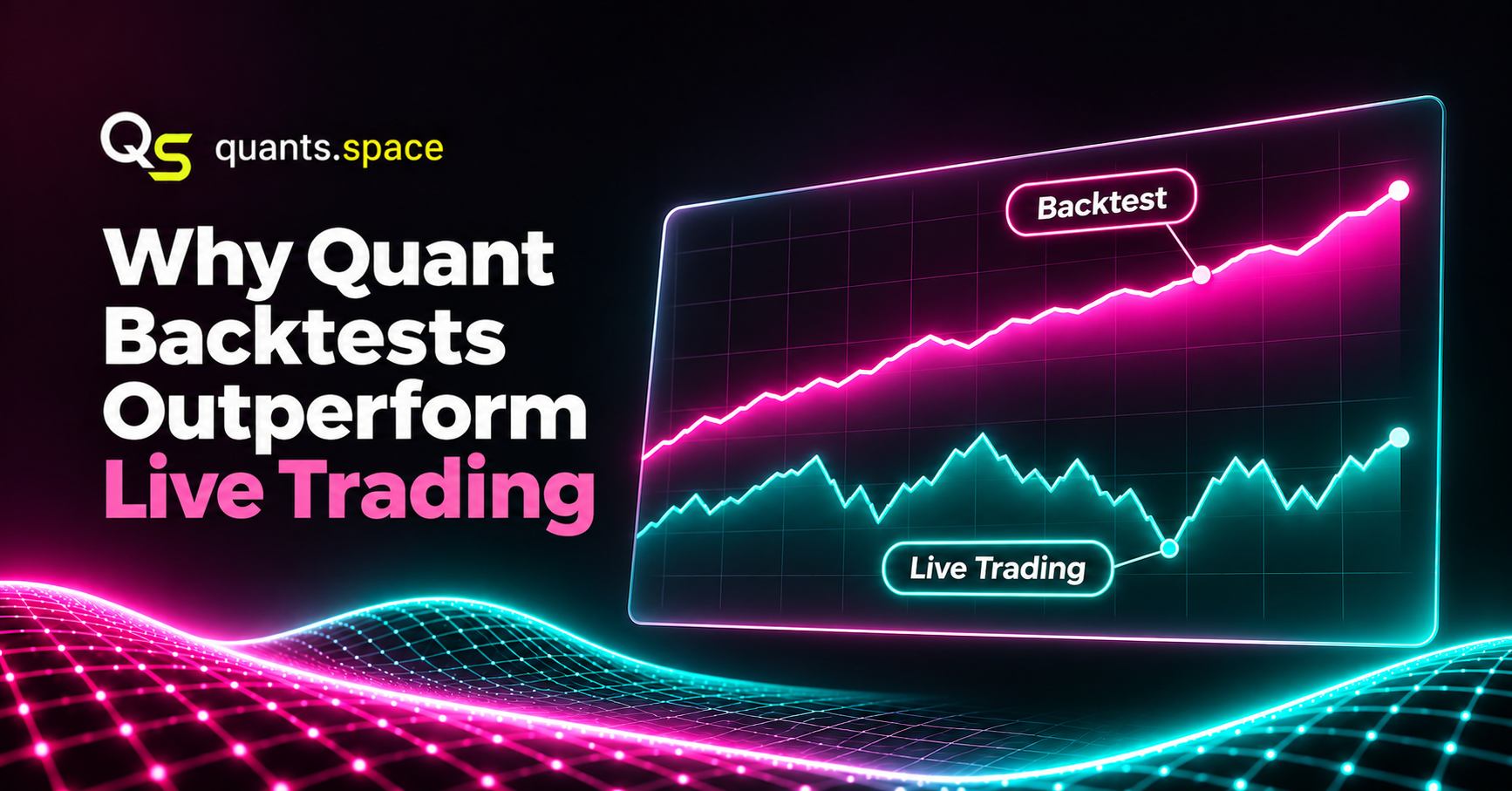
A quantitative trading strategy delivers a Sharpe ratio of 2.5 in a historical simulation. Returns appear consistent, drawdowns are manageable, and the equity curve moves steadily upward. Everything suggests that the model is ready for live trading.
Six months later, performance tells a different story. Returns are lower, transaction costs are higher than expected, and the strategy struggles during market conditions that looked harmless in the backtest.
What went wrong?
The gap between backtested and live performance is one of the most important challenges in quantitative investing. Understanding why it happens helps researchers develop more reliable strategies and allows institutional investors to evaluate track records more critically.
1. Overfitting: When a Strategy Learns the Past Too Well
Overfitting occurs when a trading model captures patterns specific to historical data rather than relationships likely to persist in the future.
Imagine a researcher testing hundreds of combinations of indicators, parameters, and trading rules. Eventually, one combination produces exceptional historical results.
But those results may reflect random fluctuations rather than a genuine trading advantage.
The more variations researchers test, the greater the risk of selecting a strategy that performed well purely by chance.
This problem becomes particularly relevant with AI-assisted research, where generating and testing large numbers of strategy variations is increasingly easy.
To reduce overfitting, researchers should use out-of-sample testing, limit unnecessary complexity, and document how strategies were selected.
2. Look-Ahead Bias: Using Information From the Future
Look-ahead bias occurs when a backtest uses information that would not have been available when a trading decision was made.
For example, a strategy might use revised economic data instead of the original figures published at the time. Another model might accidentally include a company's future financial results when calculating historical signals.
These errors can make a strategy appear remarkably accurate.
Even small timing mistakes can significantly distort performance, particularly when trading signals depend on short-term market movements.
Preventing look-ahead bias requires careful data management, accurate timestamps, and verification that every input was available before the corresponding trading decision.
3. Survivorship Bias: Ignoring the Companies That Disappeared
Historical datasets sometimes include only securities that remain active today.
This creates survivorship bias.
For example, a strategy tested on current index constituents may exclude companies that went bankrupt, were delisted, or performed poorly enough to leave the index.
The resulting backtest can overstate historical returns because it ignores securities that investors could have selected at the time.
The same problem can affect hedge fund databases when unsuccessful funds stop reporting performance.
Researchers should use point-in-time datasets that include historical constituents, delisted securities, and other relevant changes.
4. Transaction Costs Are Often Underestimated
Backtests frequently assume that trades can be executed at historical market prices with predictable costs.
Live trading is more complicated.
Commissions, exchange fees, bid-ask spreads, financing costs, and market impact can all reduce realized returns.
A strategy that trades frequently may generate attractive gross returns but become unprofitable after realistic execution expenses.
Costs can also change with market conditions. During periods of volatility, spreads may widen and liquidity may deteriorate.
Researchers should model transaction costs conservatively and test how sensitive strategy performance is to higher execution expenses.
5. Slippage and Liquidity Constraints
Slippage occurs when a trade executes at a different price from the one expected.
In historical simulations, researchers may assume that orders are filled immediately at the quoted price. In practice, available liquidity, order size, and market movements affect execution.
A strategy trading small positions in liquid markets may experience limited slippage. The same approach can become much more expensive when managing larger amounts of capital.
This creates capacity constraints.
A strategy that performs well with $1 million may produce significantly weaker results with $100 million because larger orders move prices or require longer execution periods.
Realistic backtesting should account for order sizes, market depth, and potential execution delays.
6. Market Conditions Change
Quantitative models are developed using historical relationships, but financial markets are not static.
Interest rates, volatility, market participants, regulations, and trading technology evolve over time.
A strategy that benefited from a particular market environment may struggle when those conditions disappear.
For example, trend-following strategies may perform differently in sustained directional markets than during frequent reversals. Mean-reversion strategies can face difficulties when prices continue moving away from historical relationships.
Researchers should test strategies across different market regimes and examine whether performance depends heavily on a narrow historical period.
Even extensive historical testing cannot guarantee future results.
7. The Difference Between Simulation and Real Operations
Backtests generally assume that trading systems operate as intended.
Live strategies face additional challenges, including software failures, delayed data feeds, rejected orders, connectivity problems, and unexpected broker restrictions.
Risk controls may also behave differently under real market conditions.
A strategy can generate valid signals but fail to execute them correctly because of operational problems.
For this reason, moving from backtesting to live trading often involves paper trading, limited-capital deployment, continuous monitoring, and gradual increases in position sizes.
Operational reliability is an essential part of strategy performance.
How Can Quant Managers Build More Reliable Backtests?
A robust backtesting process should challenge a strategy rather than simply demonstrate its strongest historical results.
Researchers can improve reliability by:
- Separating training, validation, and out-of-sample datasets
- Using point-in-time data and realistic execution assumptions
- Including commissions, spreads, slippage, and market impact
- Testing strategies across different market conditions
- Measuring sensitivity to parameter changes
- Documenting experiments and avoiding excessive optimization
- Comparing simulated performance with subsequent live results
No testing framework can eliminate uncertainty. However, disciplined validation can reduce the likelihood of mistaking historical coincidence for a repeatable trading advantage.
What Institutional Investors Should Look For
For institutional allocators, an impressive backtest should be the beginning of due diligence, not the conclusion.
Investors should examine how the strategy was developed, which datasets were used, and whether the reported results include realistic trading costs.
They should also ask how many strategy variations were tested, how out-of-sample performance compares with in-sample results, and whether the manager has independently verifiable live trading records.
A strategy with moderate but consistent results and transparent methodology may provide stronger evidence than one showing exceptional historical returns without sufficient validation.
Final Thoughts
Backtests are essential tools for quantitative research, but they are simulations rather than proof of future profitability.
Overfitting, data biases, execution costs, liquidity constraints, changing market conditions, and operational risks can all explain why live performance falls short of historical expectations.
For quant managers, the objective should be to develop strategies that remain robust when assumptions become less favorable.
For institutional investors, understanding the limitations of backtesting is critical to evaluating whether a strategy's apparent advantage is supported by reliable evidence.
The strongest backtest is not necessarily the one with the highest returns. It is the one that has survived the most meaningful attempts to prove it wrong.