
May 6, 2026
Quant Performance Verification Without Leaking Alpha
Read-Only API Verification: Proving Quant Performance Without Leaking Alpha
Verified track records have become a baseline requirement for institutional capital allocation. Allocators increasingly recognize that self-reported tear sheets provide an incomplete - and sometimes unreliable - view of performance. As a result, many now request read-only API access to validate trading activity directly from the source.
The principle is sound. The implementation, however, introduces a less discussed risk for the managers being evaluated.
The same process designed to establish trust can inadvertently expose elements of a manager's competitive edge.
The Proliferation Problem
A quant team raising capital may engage with dozens of allocators during a single fundraising cycle. In many cases, each allocator maintains its own verification process, data-ingestion pipeline, analytical framework, retention policy, and internal monitoring tools.
Over time, this creates a significant operational issue. A manager's read-only API credentials - and the underlying trading data they expose - become distributed across a growing number of third parties. This raises several questions:
- How is the data stored?
- Who has access to it?
- How long is it retained?
- What happens after diligence concludes?
In most cases, there is no standardized answer.
Once API access has been granted to multiple counterparties, managers often lose visibility into where their data ultimately resides.
Alpha Leakage and Reverse-Engineering Risk
Read-only access is frequently viewed as harmless because it cannot execute trades. That assumption can be misleading.
With sufficient granularity, trading data may reveal trade timing, position sizing behavior, execution patterns, venue preferences, and portfolio turnover characteristics. Taken individually, these signals may appear innocuous. Taken together, they can provide meaningful insight into the structure of an underlying strategy.
Quantitative alpha is often fragile by nature - signals decay, crowding increases, and execution advantages disappear when replicated. For differentiated managers, this creates a genuine concern.
Sharing API access with numerous independent counterparties can unintentionally distribute fragments of the firm's intellectual property.
The risk is not necessarily malicious behavior. The risk is that enough information accumulates to make reverse engineering possible.
Centralized Verification as a Structural Solution
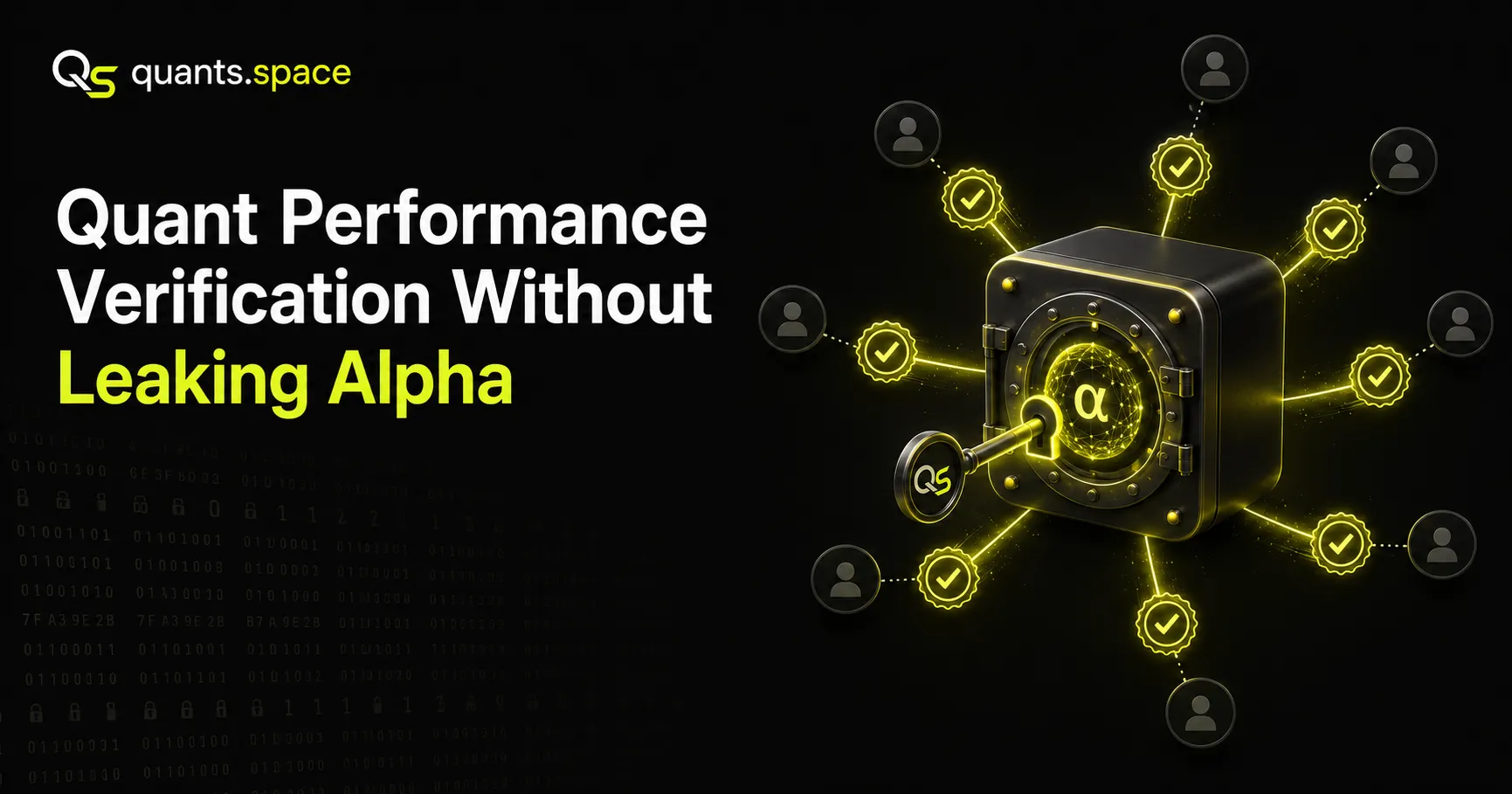
A cleaner model is single-point verification. Under this approach:
- The manager connects read-only API keys once
- A dedicated verification platform validates the performance data
- The platform generates a shareable verification report
- Allocators review the verified results without requiring direct API access
This architecture changes the trust model entirely. Instead of trusting every allocator with raw access to trading data, the model becomes trusting a single verification layer that the allocator community already recognizes.
Managers gain the ability to share verified performance while maintaining tighter control over sensitive operational information.
What Allocators Receive
A centralized verification framework does not only benefit managers. Allocators gain access to:
- Standardized performance reporting
- Consistent risk metrics
- Independently validated results
- Faster diligence workflows
- Reduced operational complexity
Instead of maintaining separate verification systems, allocators can review performance within a common framework. Typical outputs include equity curves, return metrics, drawdown statistics, risk-adjusted performance measures, and trade-level transparency where appropriate.
The result is a more efficient evaluation process with less friction on both sides.
Raising the Quality Bar
Verification also serves an important filtering function. Platforms that require source-level verification before introducing managers naturally reduce the number of fabricated track records, incomplete disclosures, and unverifiable performance claims - improving overall signal quality for allocators.
As discussed in What Makes a Quant Strategy Institutionally Investable, verification is one of the foundational requirements for institutional capital - and one that many teams continue to underestimate.
The Emerging Standard
For serious quant managers, API-key hygiene is increasingly becoming part of operational maturity. Institutional allocators now expect verifiable performance, consistent reporting, transparent validation processes, and appropriate protection of intellectual property.
Centralized verification addresses both sides of that equation - it satisfies the need for proof while reducing unnecessary exposure of proprietary trading information.
One connection. Verified performance. Controlled access.
As allocator expectations continue to evolve, centralized verification is rapidly becoming the default architecture for institutional manager evaluation.
Quants.Space verifies quantitative trading performance directly at the source, allowing managers to create a single verified record that can be shared across their allocator network.