
September 15, 2026
Three Data Problems in Quant Trading
Machine learning can find patterns in large datasets, test relationships between variables, and help build trading models that would be difficult to create manually. But there is a common myth in quant trading that enough statistics and machine learning can solve almost any trading problem.
In practice, the quality of a model depends heavily on the data it receives. Financial markets create particular challenges because useful data can be limited, relationships change over time, and mistakes in preparing datasets can make a model appear much better than it really is.
Three problems are especially important: data lack, data leak, and data drift.
Data lack: when there is not enough information
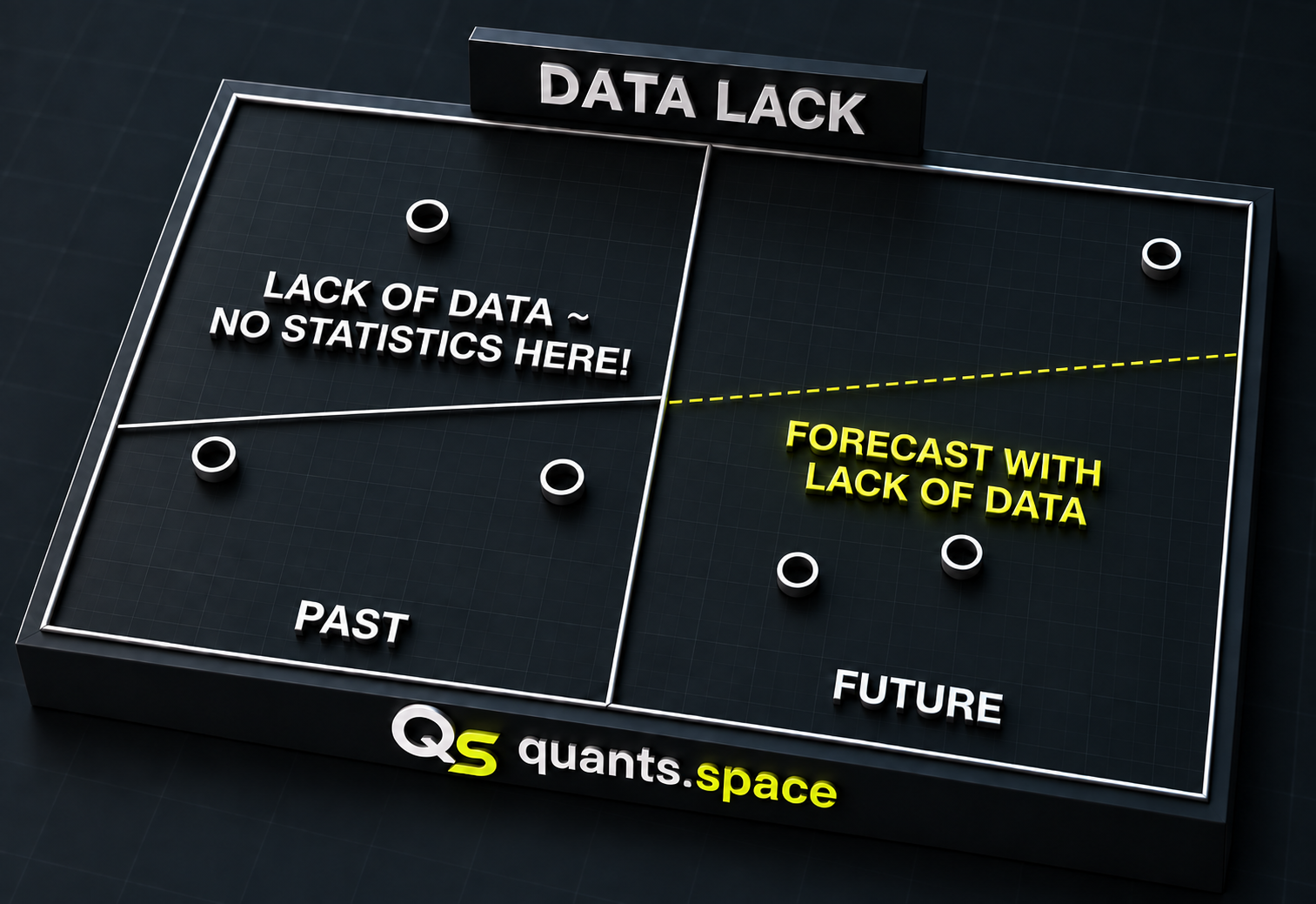
Machine learning usually works better when it has enough relevant examples to learn from. In financial markets, this can be difficult. Compared with fields where models can be trained on millions or billions of observations, financial datasets can be relatively small. CFA Institute also notes that financial data have a low signal-to-noise ratio, making useful patterns harder to identify.
The problem becomes more serious when a model needs to understand rare events. A dataset may contain years of normal market activity but only a few examples of liquidity shocks, extreme volatility, or other unusual conditions. A model can therefore perform well during the type of market it has seen many times and behave very differently when conditions change.
A small dataset also makes it easier to find patterns by accident. If researchers test enough variables and model configurations, some combinations will eventually look successful on historical data even when the relationship is weak or temporary. More complex ML models can make this problem worse because they have greater capacity to fit details in a limited historical sample.
For quant teams, the question is therefore not simply how much data is available. They also need to ask whether the dataset contains enough relevant examples of the conditions the strategy may face in live trading.
Data leak: when the model knows too much
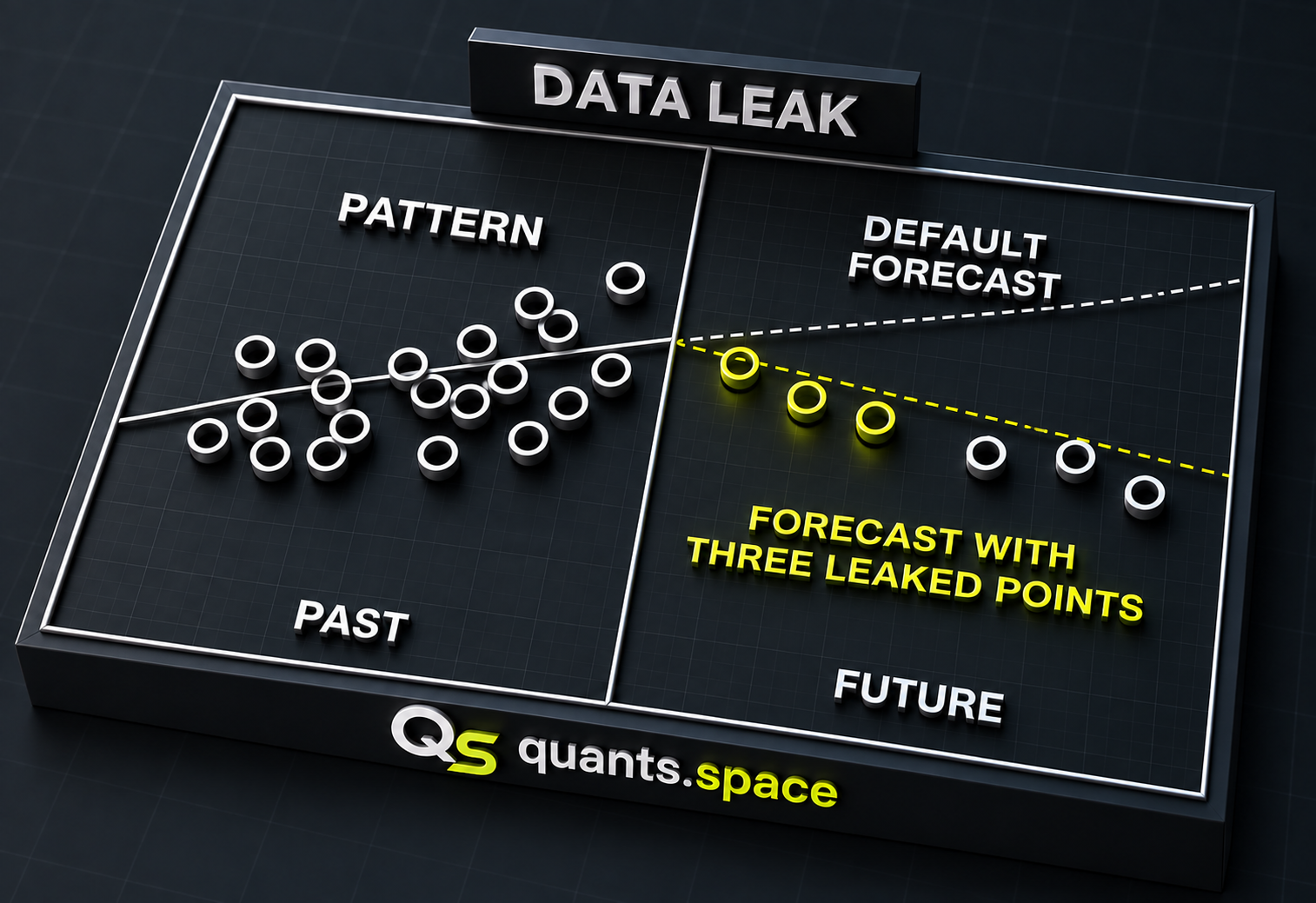
Data leak creates almost the opposite problem. Instead of having too little information, the model receives information it should not have.
A common example in quantitative finance is information from the future entering the training or testing process. Imagine testing a trading decision for January using a variable that was only published in February. The backtest now allows the model to make its January decision with information that would not have been available at the time.
The error is not always obvious. Data leakage can happen when training, validation, and testing datasets are prepared incorrectly, or when a feature contains information connected to the outcome being predicted. CFA Institute notes that leakage can make model results overly optimistic because the algorithm is effectively evaluated using information it has already seen. Live performance can then be very different.
This is one reason why an impressive backtest should be examined carefully. Strong historical performance can come from a genuinely useful trading signal, but it can also be created or inflated by problems in the research process. Look-ahead bias, for example, is a well-known backtesting problem in which information unavailable at the historical decision point enters the simulation.
A model cannot use tomorrow's information in real trading. A backtest should not be allowed to use it either.
Data drift: when the market changes
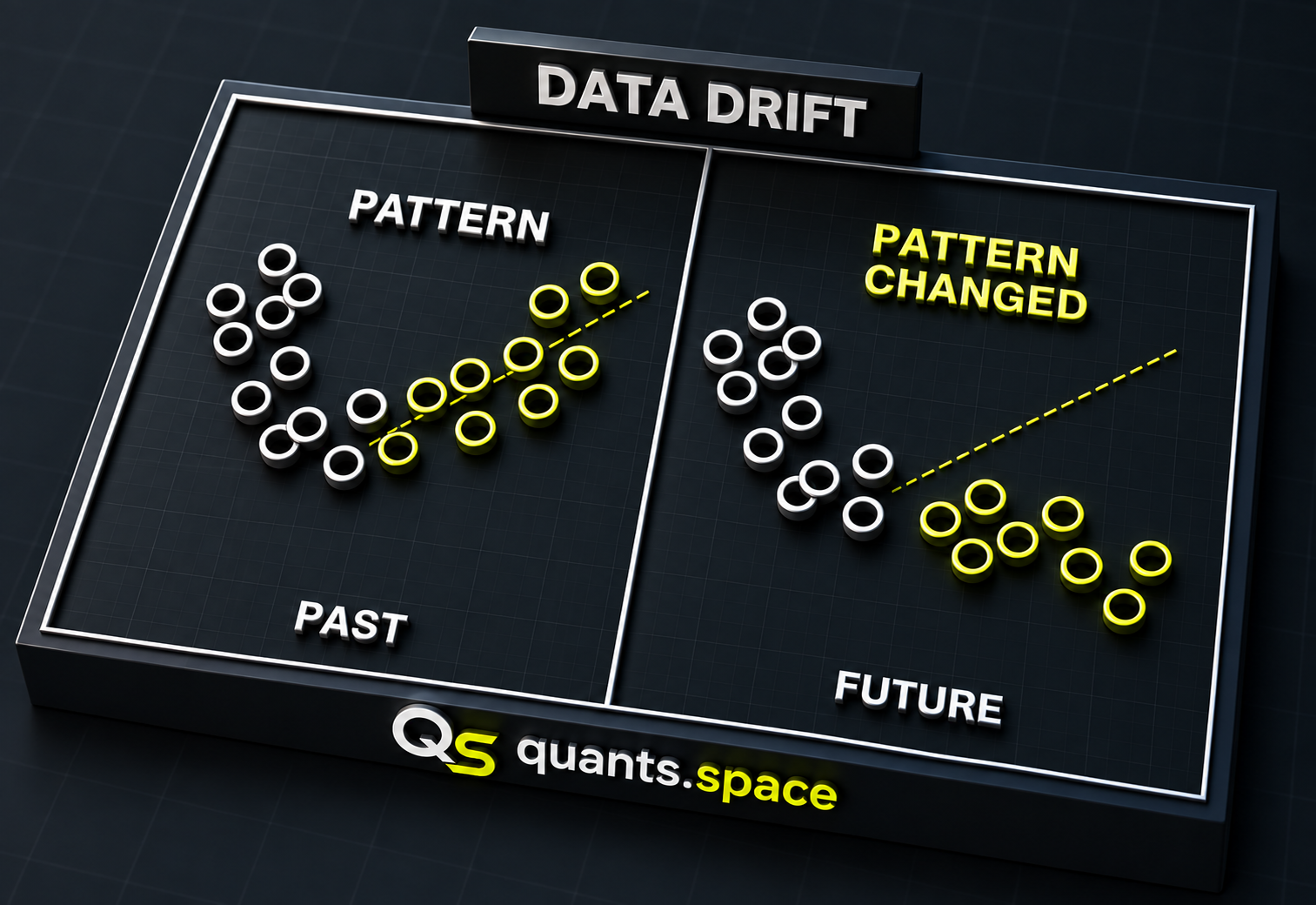
A model can be trained correctly on good historical data and still lose effectiveness later. Markets change.
New participants enter, regulations change, liquidity moves between venues and asset classes, technology develops, and trading behavior adapts. Relationships that existed when a model was trained may weaken, disappear, or change direction.
This is particularly important in finance because markets are non-stationary. CFA Institute identifies this as one of the main difficulties of applying machine learning to financial markets: unlike systems where the underlying relationships remain relatively stable, financial markets evolve over time.
Consider a model that finds a reliable relationship between several variables during one market regime. The model may have identified a real pattern rather than an accidental one. But if market conditions change, applying the same relationship to new data may produce worse predictions.
This is why good historical performance does not guarantee that a model will continue to behave in the same way. Researchers need to monitor whether the data seen in live trading still resembles the environment in which the model was developed. Structural breaks and different market regimes are also important considerations when evaluating backtests.
Why these problems matter for quant strategies
Data lack, data leak, and data drift create different problems, but all three can produce the same result: a model that looks convincing in research and performs differently in live trading.
With data lack, there may not be enough information to know whether the pattern is reliable. With data leak, historical results may be unrealistically strong because the model had access to information it could not have used in real time. With data drift, the original pattern may have been valid, but the market has changed since the model learned it.
This is also why model complexity alone tells investors very little about the quality of a quant strategy. A sophisticated machine learning system trained on weak, contaminated, or outdated data can still produce unreliable results.
When evaluating a systematic strategy, the research process behind the model matters. How was the data collected? How much history was available? How were training and testing periods separated? Was the strategy tested on information that would actually have been available at the time? And how does the team monitor whether the relationships behind the model are changing?
These questions help explain what sits behind a backtest and whether the model has a reasonable chance of behaving similarly with real capital.
Garbage in, garbage out
Statistics and machine learning are powerful tools for quantitative trading, but they cannot remove the limitations of the information they receive.
Data can be insufficient. It can accidentally contain information from the future. And even good historical data can become less relevant as markets change.
The model still matters, but the quality of the input determines what the model has a chance to learn in the first place. In quant trading, the old principle remains useful: garbage in, garbage out.